Two Worlds Self-Immolate
The seventh-century Near East didn't end. It burned through itself and became something else.
For four centuries, Byzantium and Sassanid Iran had maintained a kind of violent equilibrium — war, truce, trade, war again — across a frontier that ran from the Caucasus to the Arabian Desert. It was a brutal arrangement, but a stable one. Then in 602, the Sassanid king Khosrow II sensed weakness in Constantinople and invaded. What followed wasn't a war in any ordinary sense. It was the mutual consumption of two worlds.
The conflict lasted twenty-six years and crossed every terrain the region offered: the arid passes of the Taurus Mountains, the lush flood plains of Mesopotamia, the ancient cities of Syria and Egypt. Armies marched over the same ground repeatedly as control shifted and collapsed and shifted again. Trade routes that had sustained the region for centuries seized up. Cities that had stood since the Hellenistic period were sacked. The human cost was staggering and largely unrecorded — the kind of suffering that falls between the administrative documents that survive.
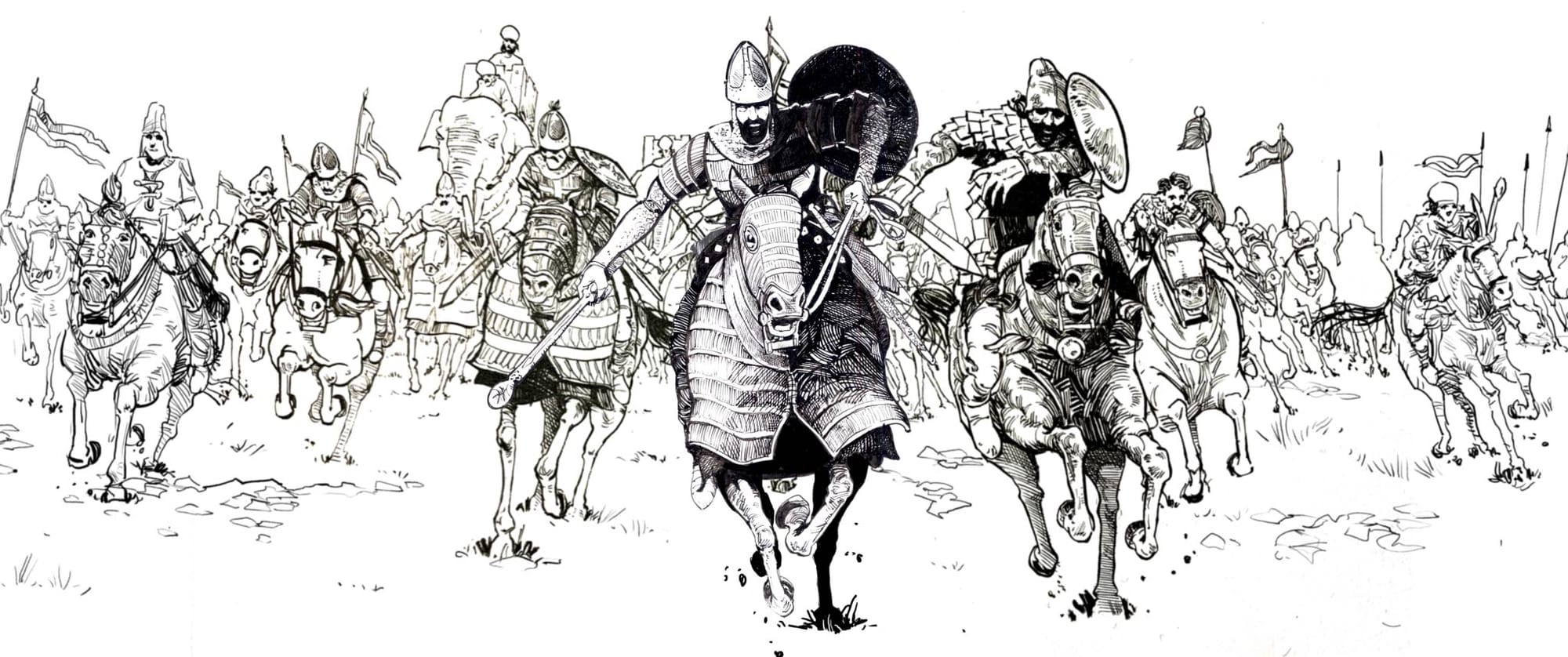
But what makes the Byzantine-Sassanid War genuinely strange, and genuinely worth thinking about, is that both empires fought it as a theological event. The Byzantines carried the True Cross into battle — the relic believed to be the wood of Christ's crucifixion, housed in Constantinople as proof of divine favour. When Persian forces took Jerusalem in 614, they looted the city's churches and carried the True Cross back to Ctesiphon. This was not incidental. It was the point. To possess the sacred object was to hold the mandate of heaven. To lose it was to lose the argument about whose god was real.
The Sassanids maintained their own cosmological claim. Their Great Kings ruled under the protection of Ahura Mazda, the supreme deity of Zoroastrianism, whose eternal sacred fires burned at the empire's ceremonial centres. The state and its religion were structurally inseparable — the king was the fire's protector, and the fire was the king's legitimacy. For Iran, this war was the defense of a theological order as much as a territorial one.
Both empires were making the same bet: that divine favour was a resource that could be mobilised, and that military victory would prove whose claim on it was legitimate. By 628, when the two sides finally negotiated an exhausted peace, neither had won that argument. The True Cross was eventually returned. The sacred fires still burned. Both empires had bled a generation into the sand and arrived back more or less where they started, except hollowed out.
This is what makes the subsequent decade so striking. Arab armies — unified under a new religion that was itself in the process of formation — struck both empires within years of the peace. They didn't conquer two powers. They walked into the wreckage of two systems that had already destroyed each other. The Eastern Roman Empire survived, reduced to a fraction of its territory, stripped of Egypt and the Levant and its most productive provinces. Sassanid Iran did not survive at all. Zoroastrianism, for which the empire had fought its last existential war, retreated over the following centuries to the margins of its own homeland.
What took their place absorbed them. The Islamic world that emerged across the 7th and 8th centuries didn't erase Byzantine administration, Sassanid court culture, or the Greek philosophical tradition. It synthesized them — and produced, in the centuries that followed, one of the most sustained periods of intellectual and artistic production in human history. The apocalyptic war had prepared the ground. The new tradition built on what the old ones had exhausted themselves defending.
The Standard Bearer takes place at the edge of this transformation, in the middle of a conflict that neither side understood as the last one. The soldiers in it are fighting for gods whose time, though neither they nor anyone else knows it yet, is nearly finished. Whether those gods were ever listening is the question the film can't answer and doesn't try to. Some things happen at a scale that makes the question of meaning genuinely unanswerable. You look at what was left behind and try to see the shape of it.
The shape here is unmistakable: the more absolutely both empires insisted on divine protection, the more catastrophically they failed. The True Cross couldn't hold Jerusalem. The sacred fires went out at Ctesiphon. What followed them was something neither empire could have imagined or permitted while intact.
That isn't folly, exactly. Or fate. It's closer to what happens when a system uses up everything it has to prove something that can't be proven. The seventh century Near East found out what comes after.

